The Tech Enabled Lawyer: Everyday Tech Essentials and AI
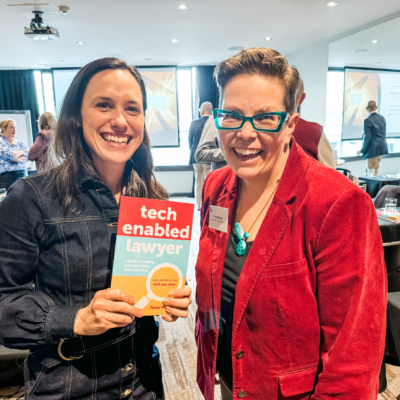
It’s not often that you wake up the morning after a conference—especially on a Saturday—feeling eager to dive into your notes and share insights with your team. But that’s exactly how Caroline, our COO, felt after the recent Future Firm Forum in Queenstown.
Within 24 hours she’d also finished the book of one of the presenters, Fiona McLay – “Tech Enabled Lawyer – a guide to making the most out of the tools you have and spotting the tech you need”.
We know tech is a big focus for many in the SHIFT Community, so Caroline has expanded on her notes below in case there are insights and tips that are helpful for others. Aligning people, process and tech has been a big focus for Caroline for nearly 15 years. She’s always up for a chat, so please do not hesitate to get in touch if you’re keen to discuss further.
With the constant flow of reports on AI in law—covering accuracy and use cases, as well as general adoption trends—it’s easy to feel that all our attention should be on AI alone.
What I loved about the Future Firm Forum, is that in addition to highlighting AI as a critical area of focus, each of the speakers also emphasised the importance of the people/human aspect of the changes we’re facing, the need for strong governance, and to also start where you and your organisation are at.
Starting where you are at and getting back to basics is a key theme in Fiona’s book “Tech Enabled Lawyer”. Before jumping to demos/trials of tech, or searching for the ‘perfect solution’, Fiona recommends following a strategic process. This includes:
- Understanding your current state – what tools do you currently have? What works? What doesn’t?
- Setting a vision for the future state – how do you want to be working in 5 years? Why do you want to change?
- Getting clear on problems – what problems do you need to solve? Are there people and process improvements that could be made before jumping to tech?
- Prioritisation – what’s most important? What aligns with strategy?
- Making impact – what is desirable, feasible and viable with the resources you have available?
With heavy workloads it can be difficult to find the time to work through these steps. From experience however, it is always worth it! And the best way to start is usually to block some time out, get in a room (solo or as a team), and start working through the questions above.
It can also be helpful to incorporate other frameworks to the discussion like Design Thinking – this helps you to:
- deeply understand all relevant users and key stakeholders
- clearly articulate problems based on insights gathered from users/stakeholders
- not jump to conclusions on potential solutions
- proceed in a cost-effective way by developing simple “minimum viable products” and bringing ideas to life for feedback before investing too much time and money.
All the steps mentioned above, from understanding your current state and vision for the future, to getting clear on all your users/stakeholders and the problems you want to solve, are also critical for exploring AI opportunities. AI is just a tool and context is key, so to get meaningful results from AI use/trials you need to be strategic. Having strong AI governance foundations is also critical and will ensure that you proceed in a responsible, safe and ethical way.
I’m really enjoying seeing guidance come through from various bodies globally on responsible AI – including Australia’s Voluntary AI Standard which was released in September.
Caroline is always happy to chat on tech, people, and process, and she has recently completed the AI Governance Professional training through the International Association of Privacy Professionals. She loves running workshops for in-house teams to create space to explore these areas, and to help set manageable and practical pathways forward.
SHARE THIS ARTICLE
SHARE THIS ARTICLE