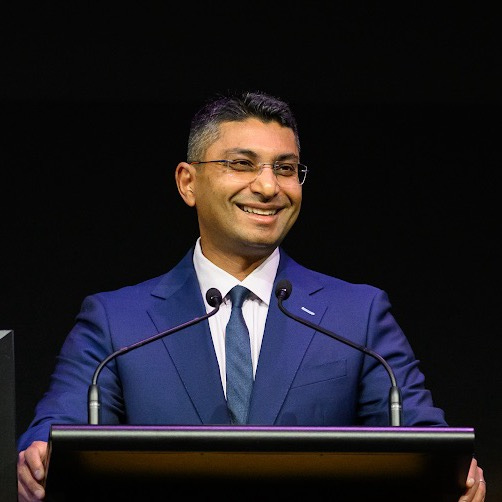
SHIFTing the conversation – Shamubeel Eaqub is the Chief Economist at Simplicity
How business leaders can help rebuild New Zealand’s fraying social fabric.
What is social cohesion?
I've been describing social cohesion as something that's easier to notice when it's not there. It's when we're polarized, fractured, and struggling to work together on big issues.
To me, social cohesion means having personal and communal trust and comfort with each other so we can get things done. It can seem like a fuzzy concept, but it shows up clearly in how we think about ourselves, about others, about politics and institutions. It's a kind of shared worldview across different dimensions.
Ultimately, social cohesion is about our ability to get along, to disagree and still move forward together. It's foundational for a democratic, open society.
The report says poverty is a key driver of the fraying of our social fabric, can you elaborate?
There are two parts to it. The first is the individual experience. When you're living in poverty, survival takes over. You don't always have the time or energy to participate socially or enjoy life. That isolation can lead to frustration and a zero-sum mentality—thinking you're poor because someone else is better off. It's not about blaming people in poverty, but understanding how hard it is to avoid developing a hardened view of the world when you're stuck in that position.
The second part is societal. People who aren't in poverty often can't relate to or understand what it's like. In our research, those living comfortably tended to say the welfare system is generous and adequate. But for those experiencing poverty, it's very different—it's painful. A quarter of New Zealanders are skipping meals because they can't afford them.
So poverty eats away at trust. And that's what we see in the data. People working hard but getting nowhere feel disillusioned. People tell us that actually you can work as hard as you want, but it's not going to get a better life. For half of New Zealanders, hard work gets rewarded. The rest feel they are stuck in low paid, precarious work, running faster on the treadmill but getting nowhere. That erodes belief in fairness—and with it, social cohesion.
How is social media compounding social fragmentation?
Social media is like the junk food of public squares — It's loud, angry, hierarchical, and obnoxious — the exact opposite of a real public space where people from all walks of life come together, share experiences, and build empathy.
The real issue is that we've replaced those authentic public spaces with this fake, toxic version. It is damaging — it siloes us, it reinforces social hierarchies, and it strips away that depth of contact we need to understand each other.
In the past, we had more opportunities for positive contact — clubs, religious communities, sports teams — spaces where you'd sit next to people different from you and work towards a shared goal. When I was growing up and played soccer, I'd meet people from all backgrounds. You got to know them as individuals, not as stereotypes. That kind of shared experience helped build empathy.
But now, especially on social media, we reduce people to labels — you're from that group, that church, that political side — and we treat each other like we're problems to be solved or converted. There's also a disconnect between how life feels for the comfortable and the struggling — and it's worsened by a lack of meaningful spaces where we see and hear each other. That's the core issue: we've lost the spaces where empathy is built. And that loss is a major fracture in our social fabric.
With trust in institutions and politicians declining, is it time for business leaders to step up?
The Acumen Edelman Trust Barometer shows that only 35% of New Zealanders trust the media, 45% trust government, 54% trust business — but 75% trust their employer. That tells us two things: first, that business is one of the few remaining trusted institutions, and second, that leaders have both an opportunity and a responsibility to step up.
.If you're a business leader, your stakeholders — your people — trust you more than they trust politicians or media. That's powerful. But it also means leadership needs to go beyond managing performance or chasing short-term results. True leadership is about looking to the future and taking your people with you.
How does social cohesion relate to business outcomes?
If you accept that our society is becoming more fractured — and I think the evidence is clear — then you also need to understand the consequences: political instability, policy flip-flopping, greater uncertainty. That kind of volatility isn't just bad for the country — it's bad for your business, your staff, and your long-term goals.
So the question becomes: how can business help smooth the path? Because if we let social cohesion continue to erode, it will absolutely spill into politics, regulation, and ultimately into disruption for your business.
What does genuine leadership look like in a time of social fragmentation — and how can leaders meaningfully contribute to strengthening social cohesion?
If you're a genuine business leader, you understand that social cohesion and prosperity aren't about everyone being the same. It's not about avoiding confrontation or pretending politics doesn't exist. In fact, it's the opposite.
True leadership recognises that difference, disagreement, and even conflict is inevitable — but also essential. We need leadership that is willing to convene — to create the space for difficult but constructive conversations. The challenge is to engage with that diversity constructively, using it as a path toward lasting, positive solutions. That's what creates the right foundation for New Zealand to thrive — and for your people and your business to succeed.
Personally, I don't have much faith that the political system will deliver the long-term, unifying vision we need. It tends to respond only in moments of crisis — when things are already broken. As the economist Milton Friedman once said, "Only a crisis — actual or perceived — produces real change. When that crisis occurs, the actions that are taken depend on the ideas that are lying around."
That's where business leadership becomes critical. Business leaders are uniquely placed to create the space — and the process — to surface those ideas. To help build consensus around what's broadly agreed, widely accepted, and ultimately good for Aotearoa. If we can agree on even 80% of what needs to happen, that's a foundation for long-term, non-partisan progress. And crucially, it doesn't need to fit into a three-year political cycle. It can be slower, deeper, and more enduring.
What practical steps can leaders take – what should they focus on?
Good leaders have humility and curiosity. Many of us — including me — live privileged lives. I don't know what it's like to live in abject poverty. But as leaders, we need to be willing to understand. That means recognising the pain that exists in parts of Aotearoa, and resisting the urge to reduce people to stereotypes.
Whether you're managing a small team or leading a major company, the best leaders see individuals. You don't see just an accountant, just a lawyer, just a brown person, or just a yellow person. You see an individual with a unique set of characteristics that you are trying to nurture and really unlock to your and their success. So being able to see beyond the stereotypes, not just in your little circle, but across a wider group, I think is important.
Because ultimately, the social fabric that underpins our economy — the stability and cohesion we all rely on — is not guaranteed. And if business doesn't help protect and rebuild it, we may not like what comes next.
Is there hope?
Of course there's hope — there's always hope.
While things are absolutely slipping, and there are some pretty big red flashing lights, like the loss of trust in media – that really worries me. That's frightening, because media is such a powerful source of connection — it's essentially our public square. And that's a public square we are losing?'.
But the flip side is this: not everyone has lost trust. We haven't become fully polarised. I'd say New Zealand today is more fractured than polarised.
And when you look at trust in employers and business, those institutions still hold public confidence. There are still parts of society — even in hardship — that people trust. In fact, even among those doing it tough, we see greater trust in neighbours and local community than we do among wealthier groups.
So no, it's not true that there's no hope. Every group still holds some hope — and some trust. There are still countervailing forces. But what we're seeing is that the experience of belonging in New Zealand is becoming increasingly different across different groups.
And that's a problem. As, while we may all agree with the idea of New Zealand, our lived experience of New Zealand is increasingly fractured. We need to bring that back — we need to restore a shared sense of the New Zealand dream.
We should be optimistic. New Zealand is a rich country — in global terms, we're wealthy. We have resources, we have opportunities, and we have a small population. So there's every reason to believe that if we can lift our awareness, coordinate better, and commit to a plan that lasts a decade, we could make real, material progress. I truly believe that.
I wouldn't have started this project if I didn't believe there was hope.
As an economist, all I can do is help with awareness and some of the guardrails. But the real action needs to come from leadership — especially business leadership.
We need business leaders to help recreate the public square, to create the processes that allow diverse views to come together, to wrestle with the big issues, and find solutions that are broadly acceptable to most New Zealanders. That's how we build consensus — that's how we find the common path.
New Zealand has done this before. There is no reason we can't do it again. In the past, it came from statesmanlike politicians. I believe now it will come from statesmanlike businesses.
SHARE THIS ARTICLE
SHARE THIS ARTICLE